


Learning to Let Loose: The Structured Life of Teresa Ricci
By Alyssa Richards

She walks into her studio in the Visual Arts building. Her space is adorned with all of the different forms of her work. Her paintings, drawings, and sculptures include pieces with broken bottoms and handles because she's not a ceramist. The studio is filled to the brim with all of her art, and two big paintings are mounted to the wall. One is of a jade green goat being protected by a bird-human hybrid, and another of a three-headed beast running into the wilderness. Scattered across her desk are oil paints, charcoal sticks, an array of paint brushes (both big and small), a 64-pack of crayons, and a drawing in a sketchbook colored with the crayons right in front of it.
The studio and the sketchbook both belong to Teresa Ricci, a second-year painting and drawing MFA student at Purchase College. Before joining the MFA program, Ricci worked as an art instructor at Arlene’s Atelier in her hometown of Albany. In her position, she taught oil and acrylic painting, bookbinding, and gouache, among other subjects. Upon coming to Purchase, Ricci was a teaching assistant twice, allowing her to teach a class on her own: Introduction to Drawing. Though Ricci is experienced in teaching others, she still has room to grow on her own. She describes herself as “Type A,” meaning she’s very by the books in terms of waking up early, having a daily agenda, and having multiple modes of organization. While this may seem like a benefit, in Ricci’s case, it affects her ability to develop her art.
“I had multiple wonderful faculty last year tell me that I should play more in my paint.” Ricci pauses. “And I just couldn't wrap my head around that because I'm like, well, how am I supposed to do that? But I think I'm getting there. I'm not exactly there, but I'm getting there.”
Ricci sees herself as strict about how she creates art, but her preferred mediums deflect that: charcoal and oil paint.
“Charcoal…” she trails off. “It’s such a mess. I think that's why I like instinctive oil painting, 'cause I said before, I'm so type A. It's kind of nice to have a medium that forces me to be not that. You’re kind of at its mercy for both of them.”
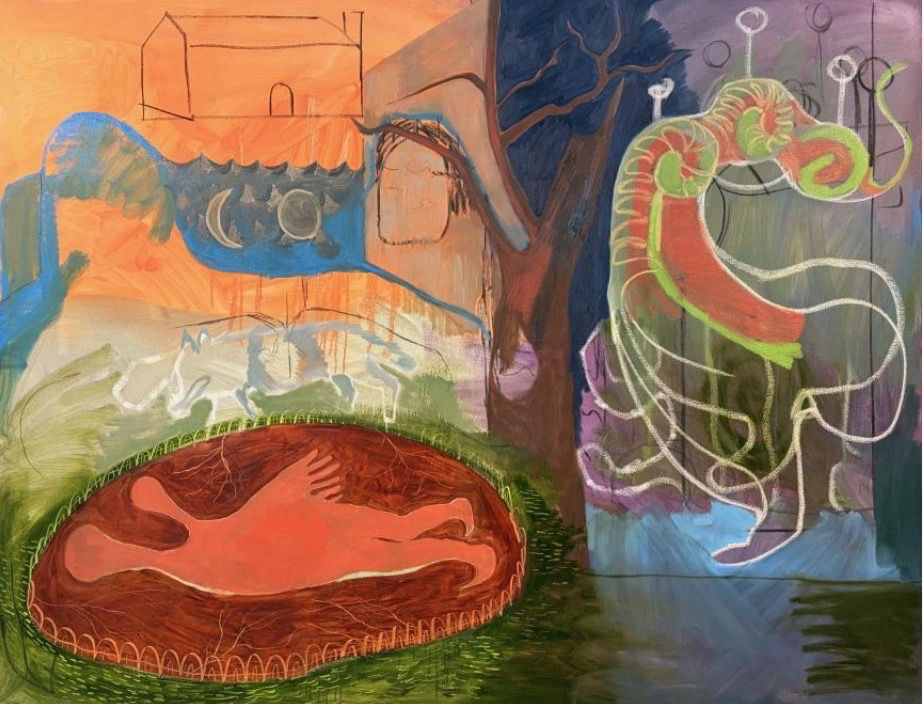
Ricci is currently working on an oil painting for herself, or as she describes it, “self-motivated grad work.”
She describes the work as, “…multiples wolves watching over a buried figure with wings. Behind them, there is a scene with a floating house. A tree thinly divides one world into the next. There will be a beast with some ocean. I don’t have the specifics yet.”
Ricci typically plans her paintings. She draws a “really rough and lousy” sketch, or multiple sketches if she’s struggling with an idea. But if an idea in the sketch doesn’t work out regarding the painting, she changes it — she doesn’t want to feel tied to the sketch.
Demi Johnson, second-year MFA student, notices this whenever she goes into Ricci’s studio. She believes that Ricci experiments with her art in two ways: loosening up and refining.
Ricci refines her work by making a piece one day and going over all of it the next.
Johnson recalled, “There are times where I go in one day, and it’s a rough sketch of colors, an idea of something. Then the next day, it’s totally reworked. A whole new composition and maybe different color choices. She’s really not afraid to do the whole ‘kill your darlings’. Nothing’s too precious.”
In addition to her typical mediums, Ricci has recently started using crayons. She feels like she can play a bit more with them, without the planning she associates with oil paint.

“We've been working with little crayons and seeing the way that the childlike medium has been able to cross over into her sketching style, there's an inherent looseness that comes with working with non-traditional media that's gonna be shown within the sketches that she makes,” said Johnson. “Those sketches then become paintings, so that looseness is transferred into the paintings.”
One colorful drawing in her sketchbook has text in the bottom left corner that reads, “Please watch over him. Please keep him with us. Please protect him.” Ricci created this piece while thinking of her sick father. Anubis, the Egyptian god of death, appears in the piece. Rather than welcoming death, Ricci uses Anubis to ward it off. She said that it’s her way of keeping him safe.
Ricci’s grief over her father’s illness may affect the art she makes, but she impacts the artists around her.
“Being here and seeing how she's adapted her drawing into her work has honestly influenced me to start drawing more, which I have, and that's part of my practice more heavily than ever before,” said Johnson. “It's been really helpful to be around someone who isn't afraid to experiment a little bit with their style."
Ricci’s work is sought after by Georgina Adams, senior psychology major, who loves her work and says it's captivating. She even posted a photo of one of Ricci’s ceramic vases on her Instagram page.
As for why she posted it, Adams said, “I want any of her work. I’ve been trying to get a piece from her for so long.”
She scrolled through Ricci’s Instagram page, noting that some of her posts had been taken down. Some were from her “era” of pieces featuring oranges and pinks, muted colors, and brighter pieces with muted colors. Still, she recalled one of her favorite pieces.

“One of my favorite paintings from her is this one- oh, she took it down. It was so beautiful. It’s of this naked woman, and this dog, and it was during this era where she was using oranges and pinks. … But it was just so stunning. The woman's figure and the dog were so realistic and so pretty and it looked like it would be in a castle, hung up on a tapestry or something,” said Adams.
Ricci appreciates and trusts Adam’s feedback, admitting that she took a lot of time on the piece.
Back at her home in Albany, Ricci gardens with her mother. She began to garden before coming to Purchase and views it as a way of reconnecting with her family. She also draws connections between roots, human veins, and the idea of becoming one with the earth.
Ricci’s artist statement mentions Mother Nature, a connection she traces to her mother. Her mother is a gardener, and being from Albany, her backyard is constantly filled with nature. Bunnies and birds in the backyard also find their way into Ricci’s paintings.

Her artist statement was written in collaboration with Dave Walsh, her previous mentor at the MFA, who she notes as most influential.
“All my mentors have been incredibly influential in my work. But Dave made me question a lot,” she said. “Not as like, crisis question, as in thinking critically about what you’re doing and why you do it. It helped me so much. I think because I worked with him last semester, I was able to evaluate over the summer and then come to where I am now.”
Walsh’s mentorship helped her to rethink the way she creates art. Particularly, two pieces named “End Season” and “Long Distance Call.”


“These pieces started with multiple experiments in surfaces and textures. There were plenty of failures, but these were wonderful to work on,” said Ricci. “I was also encouraged to push through them instead of giving up when I started to struggle.”
Ricci’s artist’s statement also says that her father showed her kaleidoscopic music videos that influenced a “psychedelic worldview.” One was Pink Floyd’s “Welcome to the Machine,” which scared the “living shit” out of her when she was just eight years old. She described it as an “amalgamation into weird, grotesque beasts.”
That psychedelic worldview carries into her art. Alex Patrick Dyck describes Ricci’s work as a “mythological bestiary."
Dyck is a second-year MFA student, and they believe Ricci’s work comes off as a mythological bestiary because the creatures she draws aren’t real, but strange.
“I think strangeness really appeals to Teresa,” they said.
Along with studying in the MFA program together, Dyck and Ricci co-curated their first-year MFA exhibit in March of 2025, “Somewhere, Elsewhere.”
“I have a lot of experience in the art world curating and being in group shows and it's not easy. Working with Teresa was great because I feel like we trust each other. We trust each other and we trust each other's vision. I might have more experience with curating stuff, but I know Teresa knows what looks good because her taste level is like. She has a high taste level,” Dyck said.
Ricci acknowledged that Dyck has more curatorial experience than she does. However, both were able to experiment with placement, communicate, and come together to complete the exhibit.
Dyck said, “This stereotypical type A, I’m just like, I don’t know. I think that Teresa’s more complex than that. She does have a hard time loosening up, but I think it’s in there. You know, I have not given up on her wildness.”
Ricci is set to be featured in an upcoming MFA show in the Richard and Dolly Maass Gallery titled “Threshold” on Nov. 18 and is on view until Dec. 8.


Comments