


NYPIRG Holds Higher Education Action Day as CUNY and SUNY Schools Advocate to State Legislators in Albany
- Mar 2
- 8 min read
By Shaya Silberstein
On Wednesday, Purchase College joined over 50 combined State University of New York (SUNY) and City University of New York (CUNY) schools as part of Higher Education Action Day with the New York Public Interest Research Group (NYPIRG). Each traveled to the state capitol in Albany to advocate to assembly members who are currently part of the negotiating stages of the New York State budget in the Capitol building.
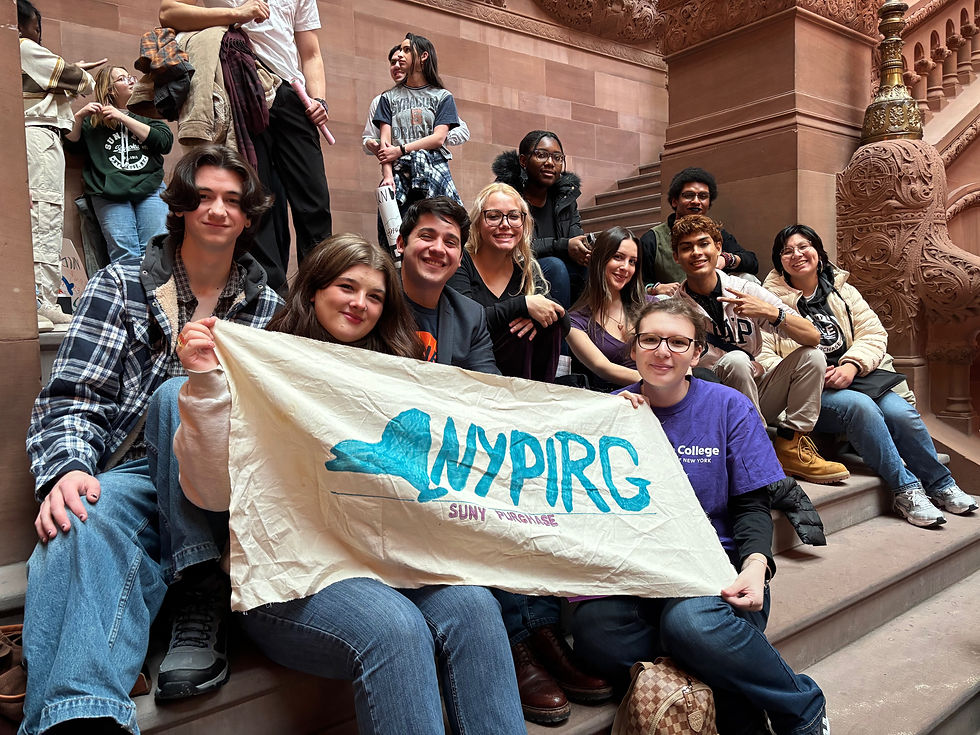
“Higher Education Action Day is something we do every single year,” said Alex Bornemisza, the Western New York regional coordinator with NYPIRG. “Higher education is being dismantled piece-by-piece since the 1980s. Whether we’re talking about the Reagan era, Clinton era or about the Obama and now the Trump era. We have seen our higher education system funding cut, and we have seen programs cut across the state. Student debt has been increasing, and the overall experience of college is becoming worse year after year. So, every year we come to Albany to make sure, at least for New York state, we fight to make sure students get more aid, [and] that the schools get more funding and more aid. We have schools falling apart across the country, and we need to save our higher education institutions, which are under threat more than ever.”
NYPIRG at Purchase went there with specific goals in mind, as Gov. Kathy Hochul proposed increasing SUNY operating aid by $49.3 million. SUNY would need a total of $141.8 million for the 2027 state budget. SUNY Purchase would also need some increase in funding. “Four main goals today were talking to our legislators about our increase in operation aid for Purchase,” said Matthew Paolucci, project coordinator for NYPIRG. “That affects everything from services we provide on campus to the professors that teach on campus, to opportunity programs.”

The biggest issue NYPIRG went to Albany to advocate for was critical maintenance, following the recent boiler failure and heating issues on campus.
“SUNY Purchase has a $542 million critical maintenance backlog, the highest of all 32 SUNY comprehensive campuses in the system,” Paolucci said about the need for funding critical maintenance. “We met with our legislators today to hammer that point home and to talk about recent problems we’ve been having with our infrastructure.”
“I’m really just hoping that legislators and their staffers listen to us,” said Meghan O’Keefe, a visual arts major. "I know I plan to bring up the critical maintenance issues, and how Purchase is ranked last in the backlog of necessary critical requirements. It has really impacted me over the past couple of weeks, not having access to the Visual Arts building, just to complete my basic homework assignments. I’m really hoping we can get a point across to legislators and get the funding we desperately need.”
A press conference was held at 11 a.m. on the Million-Dollar Staircases in the Capitol building. All of the CUNY and SUNY students surrounded the staircases as different project coordinators rallied for an hour about what they were advocating for.
After the rally ended, different groups met with legislators for advocacy meetings. “Purchase NYPIRG was spread across three delegations," said Paolucci. “First delegation met with State Senator Shelley Mayer and Amy Paulin, an assembly member. My team met with Dana Levenberg, an assembly member, and Steven Otis, an assembly member who’s a representative for the college. On the budget side, we met with the top-ranking assembly member for the Ways and Means Committee.
“We had a third group of Purchase delegates, a much smaller group as part of the leadership delegation, which met with the leaders across New York state government, Andrea Stewart-Cousins, who leads the senate, and dropped off the material to Carl E. Heastie, who leads the assembly. There was also a meeting with Toby Ann Stavisky, who is high up in the chambers. So overall, we had lots of meetings with lots of legislators.”
Each group had student leaders; the first Purchase NYPIRG group met with Sen. Katherine Fennell, the education committee director, as part of Sen. Shelley Mayer's office.
Students shared their stories in meetings, as one of the student leaders started, with Emily Magnan, a political science sophomore, talking about issues with the health services on campus.
“We currently have two practitioners and one nurse for the entire campus, for about 3500 students. I ran into an issue a few weeks ago, in the first week of February, and I got sick. I had to wait a day and a half to get an appointment, and they didn’t have anyone in to see me. When I finally went in, they told me that I had caught them on their last day. They weren't able to actually see students for over a week,” Magnan had found out this was the same week that the younger children in elementary school and middle school had their break. “I guess both practitioners have children that week for break, they both had scheduled the week off as set in the school calendar. Unfortunately, I was told there used to be four practitioners and three nurses. Now down to two practitioners and one nurse.”
Magnan had seen this practitioner on a Wednesday. She was informed that if she had to see a health care provider by that Wednesday and the following Friday, she would have to go off campus to an urgent care or a hospital. “In the middle of that week, there were no practitioners available; the entire campus received an email about how there were high respiratory infections and the flu season. It was a warning about the area, and said flu vaccines are available at health services. Yet if you called them, there is staff, but no one who can administer it. This is a staffing and funding issue.”

Another goal that Purchase NYPIRG wanted to talk about was the transit issue on campus. “Westchester County has proposed to cut B-Line Route 12,” said Nikko Gambino, a political science sophomore and the transportation intern at NYPIRG, “which provides services to Purchase and the surrounding area. Research conducted during the planning stage does not account for the consequences it would have for Purchase College and many others who rely on Route 12. The cut to Route 12 means a greater burden on the currently provided Purchase College-run bus services, which already struggle to meet high demands with low capacity. Students, faculty and staff all rely on Route 12 services, and a cut would halt their ability to get to and from campus and fulfill their roles within their campus community.
“We are calling on the county to recognize and act on Purchase and community needs for Route 12, by reopening the planning process and ultimately revising the current plan that the county outlines to be more efficient, and that Route 12 is not hindered and expanded on.”
Another goal that was important was talking about the opportunity programs, like the Educational Opportunity Program (EOP). “Purchase was chosen to be an expansion of EOP,” said Paolucci. ”It has been very successful; half of the incoming freshmen for the class of 2029 are in opportunity programs, including EOP. The program provides a dedicated academic advisor and a textbook stipend for students. By all means, they were so successful that they underestimated how many students would join EOP, which means it needs more funding. We want to lobby for an extra two and a half million dollars to fill the underfunding, and an extra $17.5 million, so a total of $20 million to account for future demands.”
This would include the growth of the stipend and help grow the program fully.
One of the students in EOP spoke in the meeting with Fennell about how EOP has helped him. “I was admitted to Purchase through the EOP program,” said Jason Dobbins, a journalism sophomore. “To take away the budget would be to remove a lot of students throughout the city and the state from getting to college. EOP helps with money, and the housing deposit is usually $250; with EOP, it is $25. They know we work with such a tight budget of file dependence override. The program has helped me because we get our own designated counselors, and we are able to reach out.
“To lose the funding would be losing those councilors who are designated to help us. From my perspective as an EOP student, it has been more helpful to go to my EOP advisor than my academic advisor. It is a program that has benefited my time at college and has helped me find a lot of valuable resources. I’m asking this as an EOP student, who is able to restore the budget, can restore the $2.6 million that is being attempted to be taken away, and add the 17.5 million.”
54 SUNY campuses have over 9,000 students in EOP. Since 2022, EOP has grown by 21%, and state funding has grown by 3%. The executive budget decreases EOP by 6%.
Purchase NYPIRG was advocating for $1 billion dollars for critical maintenance, $600 million for shovel-ready projects, and $400 million for emergency-avoidance projects. At the same time, the emergency and needs for the entire system are estimated to be about $10 billion.
O’Keefe shared her story of the problems at Purchase in the meeting with Fennell. “I’m in the conservatory program for visual arts. With the boiling breaking, all the academic buildings and the library were closed for that week and a half. It made it impossible to complete my coursework virtually. I need in-studio time as my coursework requires being in the print shop. Doing virtual classes is brutal, and I wasn’t able to accomplish any of my coursework just based on accessibility to the facilities. It’s been extremely difficult for my learning and general education this semester.”
Purchase NYPIRG also met with Audrey A. Hollick, the legislative council, part of the assembly member Amy Paulin's office.

As part of the meeting, NYPIRG talked about the food issues on campus. "Food insecurity is an issue on campus,” said Orion Morgan, a junior screenwriting/playwriting major and black studies minor, who is a part of Empire State Services Corp and Basic Needs/Snap Outreach Cohort. “From what I have seen, there's not a shift in the food pantry where I work, without at least 10 people going to pick up food. We also host our mobile food pantry once a month, and a good amount of people show up. Also, with the Food Recovery Network (FRN), we pack up leftover food from events to put in the refrigerator. Only a day can pass by, and the fridge will be empty. I say these examples to show that food insecurity is a prevalent issue, and it obviously affects students mentally and physically. I feel there can be easy solutions, as more programs for students need food, there should be more backup plans for the need for food.
“For example, last semester, when SNAP was getting cut, and people lost access to it, my boss said, ‘You might have to do research on other food pantries that were not confident they would have enough to give to students.’ It’s an issue that there are no backup plans if, let's say, SNAP goes underneath again. The solution from the government was to have more Empire State service workers working more at food pantries. I don’t think that was a good solution. A permanent solution would be having programs to rely on.” Morgan is trying to make a meal-swipe donation program start at Purchase.
More stories about the critical maintenance problems were being shared. “In my dorm, my heater completely broke, leaking water all over the floor,” said Zak Barrera, a sophomore sociology major. “It leaked all the way to the bottom of the floor, so other dorms were also affected. We were given a space heater then, which is a fire hazard, since there is water on the floor, and [it was] plugged into the wall. We issued a maintenance report three weeks ago and still haven't heard back. There is no urgency. We just have this space heater that barely works and keeps falling over. It has been really unfortunate living conditions.”
The messages will be passed to the office of Mayer and Paulin, as they look to increase funding in the state budget for SUNY Purchase and all colleges across New York.


Comments